


 Filter Filter
10.52843/cassyni.q8kt1r
- Nov 15, 2023
- Paul Linden
The stratified inclined duct (SID) is a relatively new experimental paradigm that produces a sustained shear flow between two counterflowing layers of fluid supplied by reservoirs at each end of the duct containing fluids of different density. The duct can be tilted at a small angle θ to the horizontal and, for a given fluid, the flow is determined by two nondimensional parameters θ and the Reynolds number. We have observed four different flow regimes in SID: Laminar when the interface between the layers remains undisturbed, Holmboe characterised by sharp cusped waves on the interface, Intermittent when the flow has bursts of turbulence followed by relatively calm periods and Turbulent when the turbulence occurs throughout the duct and is sustained in time. The laminar regime occurs at low Re and θ, and transitions to the other regimes occur successively as Re and θ increase, so SID allows a systematic study of the different regimes. One of the most important questions in stratified turbulence is the efficiency with which the fluid is mixed. When the stratification is stable, with density decreasing with height, work needs to be done against gravity to move light fluid downwards and dense fluid upwards so that irreversible mixing can occur. The ‘tax’ that this irreversible mixing imposes on the kinetic energy of the flow, the so-called ‘mixing efficiency’ is important to parameterise mixing in ocean and climate models. In this talk I will discuss the philosophy behind SID and explain why the experiment is relevant to this issue, particularly in the context of the energetics of the flow. We focus first on the self-organisation properties of the flows, wherein more strongly turbulent flows tend to an asymptotic state characterised by a uniform gradient Richardson number of order 0.1-0.2 across the shear layer. We then summarise our results on turbulent energetics and mixing statistics. We derive the kinetic and scalar energy budgets and explain the specificity and scalings of SID turbulence. We assess the relevance of standard mixing parameterisations models, and we compare representative values with the literature. The dependence of these measures of mixing on controllable flow parameters provides asymptotic estimates that may be extrapolated to more strongly turbulent flows. Complementing the experiments we introduce the first accurate 3D DNS for SID. Implementing a suitable forcing method and boundary conditions allow us to maintain steady exchange flow for an arbitrarily long time at a minimal computational cost. With the newly developed numerical model, we explore the diverse transitions in SID from a numerical perspective.

10.52843/cassyni.211m74
- Nov 15, 2023
- Alexander De Klerck
In logical geometry, Aristotelian diagrams are studied in a precise and systematic way. Although there has recently been a good amount of progress in logical geometry, it is still unknown which underlying mathematical framework is best suited for formalizing the study of these diagrams. Hence, in this paper, the main aim is to formulate such a framework, using the powerful language of category theory. We build multiple categories, which all have Aristotelian diagrams as their objects, while having different kinds of morphisms between these diagrams. The categories developed here are assessed according to their ability to generalize previous work from logical geometry as well as their interesting category-theoretical properties. According to these evaluations, the most promising category has as its morphisms those functions on fragments that increase in informativity on both the opposition and implication relations. Focusing on this category can significantly increase the effectiveness of further research in logical geometry.

10.52843/cassyni.3wh6w7
- Nov 7, 2023
- Lou Cattafesta
This presentation describes applications of conditional spectral analysis to fluid dynamics. In the first part, we describe a general noise-removal technique via a multiple-input, multiple-output (MIMO) framework capable of removing an arbitrary number of possibly coherent contaminating noise measurements, regardless of their order, from multiple sensor measurements. An application example to unsteady surface pressure measurements in an air wind tunnel is provided to demonstrate the technique. In the second part, we present spectral analysis modal methods (SAMMs) to perform POD in the frequency domain using non-time-resolved particle image velocity (PIV) data combined with unsteady surface pressure measurements. Here, time-resolved unsteady surface pressure measurements are synchronized with non-time-resolved planar PIV measurements acquired at 15 Hz in a Mach 0.6 cavity flow. Leveraging the spectral linear stochastic estimation (LSE) method of Tinney et al. (Exp Fluids 41:763–775, 2006), we first estimate the cross-correlations between the velocity field and the unsteady pressure sensors via sequential time shifts, followed by a Fast Fourier transform to obtain the pressure–velocity cross spectral density matrix. This leads to a linear multiple-input/multiple-output (MIMO) model that determines the optimal transfer functions between the input cavity wall pressure and the output velocity field.
10.52843/meta-mat.4bblf3
- Nov 7, 2023
- Erik O Hiltunen
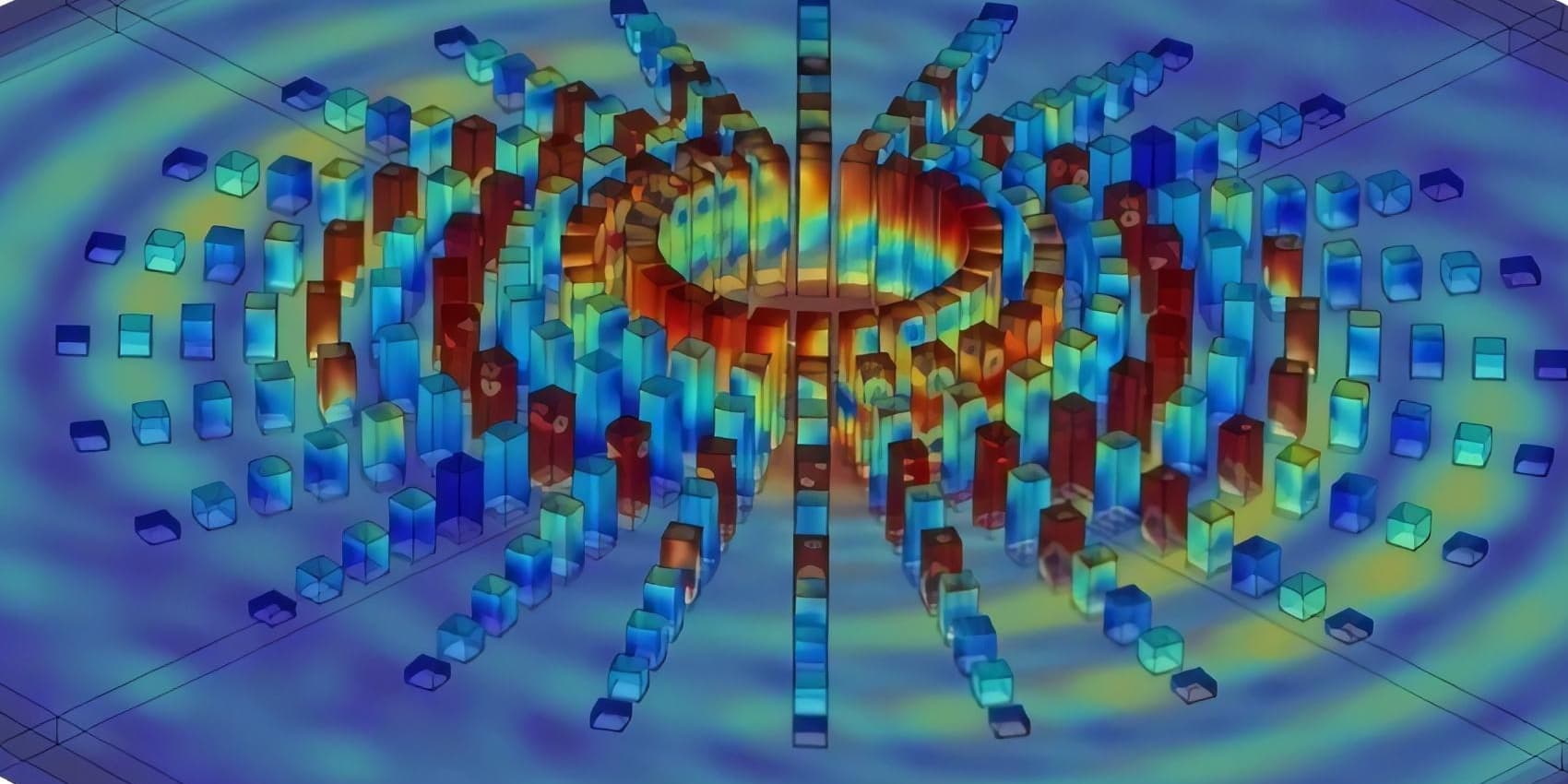
The field of photonic crystals is almost exclusively based on a Maxwell model of light. To capture light-matter interactions, it natural to study such systems under a quantum-mechanical photon model instead. In the real-space parametrization, interacting photon-atom systems are governed by a system of nonlocal partial differential equations. In this talk, we study resonant phenomena of such systems. Using integral equations, we phrase the resonant problem as a nonlinear eigenvalue problem. In a setting of high-contrast atom inclusions, we obtain fully explicit characterizations of resonances, band structure, and Dirac cones. Additionally, we present a strikingly simple relation between the Green’s function of the nonlocal equation and that of the local (Helmholtz) equation. In particular, we generalize existing lattice-summation methods to the nonlocal case. Based on this, we are able to achieve efficient numerical calculations of band structures of interacting photon-atom systems.

10.52843/cassyni.lxg1k8
- Oct 24, 2023
- Takahiro Fujioka
Water treatment using a nanofiltration (NF) membrane is an effective advanced water treatment process for achieving high organics removal. This presentation will cover our recent studies examining the feasibility of direct (i.e., no pre-treatment) NF treatment of surface water and wastewater using a submerged flat-sheet NF membrane module. When a direct NF system was employed for surface water treatment, we observed only slight membrane fouling over three months. The separation performance of the NF system remained high: total organic carbon (TOC) removal remained at 80-90% in most sampling occasions. Membrane surface characterization revealed that many substances covered the membrane surface. It was speculated that these substances deposited on the membrane surface provide a small contribution to the hydraulic resistance. Further, the membrane foulant was readily removed by physical cleaning, and the permeability fully recovered. This indicates that the membrane foulant did not penetrate the pores of the NF membrane. The results attained through the on-site test suggest the viability of direct NF treatment of surface water for achieving high water quality and stable system operation. In addition to the drinking water treatment, the presentation will provide the results of applying the direct NF system for wastewater treatment.

10.52843/cassyni.v6j444
- Oct 24, 2023
- Andrew Schulz
The recent increase in public and academic interest in preserving biodiversity has led to the growth of the field of conservation technology. Conservation technology involves the construction of technology and tools and interfacing them to aid in the conservation of wildlife through collaborations or technology interventions. Creating the tools to conserve both fauna and flora is incredibly challenging and can be toxic if not approached with specific ideas in mind. In this talk, I will present some foundational framework for developing conservation tools (CT) based on human-wildlife interaction and human-wildlife-centred design. This will be followed by five case studies ranging in complexity from cat collars to machine learning and game theory methodologies. Conservation technology not only has the potential to benefit biodiversity but also has broader impacts on fields such as sustainability and environmental protection. By using innovative technologies to address conservation challenges, we can find more effective and efficient solutions to protect and preserve our planet’s resources.

10.52843/cassyni.nnp19m
- Oct 24, 2023
- Robin Leister
The optical measurement technique Defocusing Particle Tracking Velocimetry (Defocusing PTV) is applied to the sub-millimeter gap of an open wet clutch to gain deeper insights into the unknown flow, which causes a significant loss in nowadays automobiles. The present work improves the fundamental understanding of the flow and its contribution to the generated drag torque and the physical process of aeration. A set of governing analytical equations is revealed from in-depth theoretical considerations, which describe the general cause-effect relations of the flow. To gain deeper insights into the unknown intra-groove phenomena Defocusing PTV is successfully applied to (locally) extract precise vortex information and fine resolved wall shear stress values. Metrological insights are generated with the introduction of a new detection strategy and the proven flexibility of Defocusing PTV, which makes comprehensive magnification and location-accuracy studies possible. The work is completed with a flow analysis along the entire radial region of interest, and the consideration of a more complex groove geometry.

10.52843/cassyni.pr639f
- Oct 18, 2023
- Maristela Rocha
We show how a semantics based on Aristotle’s texts and ecthetic proofs can be reconstructed. All truth conditions are given by means of set inclusion. Perfect syllogisms reveal to be valid arguments that deserve a validity proof. It turns out of these proofs that transitivity of set inclusion is the necessary and sufficient condition for the validity and perfection of a syllogism. The proofs of validity for imperfect syllogisms are direct proofs without conversion in a calculus of natural deduction. Transitivity of set inclusion turns out to be a necessary condition for the validity of imperfect syllogisms. As a consequence, it can be established what the main metalogical difference between a perfect and an imperfect syllogism is. The validity of the laws of conversion is also obtained by direct proofs. Finally, it is shown that and explained why some imperfect syllogisms satisfy the definition of a perfect syllogism.

10.52843/cassyni.bn9673
- Oct 16, 2023
- Eric Sonnendruecker
Many plasma physics models have been proved to possess a non-canonical hamiltonian structure. Invariants like the hamiltonian or Casimir invariants like div B = 0 follow immediately from this structure. Hence discretizing the infinite dimensional hamiltonian structure so that we obtain a finite dimensional hamiltonian structure provides a natural way to conserve discrete invariants. After a short review of geometric discretization for kinetic and hybrid fluid-kinetic models, we will focus on structure preserving discretization of compressible ideal MHD. In order to robustly handle shocks and also keep the symmetries inherent to the MHD model, we will introduce a semi-implicit hybrid model coupling Finite Element Exterior Calculus and Finite Volume schemes. A splitting approach is designed so that we may take advantage of the conservation properties and robustness of the Finite Volume schemes for the non-linear advection, while relying on a structure-preserving discretization of the magneto-acoustic terms based on Finite Element Exterior calculus. Moreover, the nonlinear convective terms are treated via an explicit time-discretization, while the magnetic and acoustic terms are solved via an implicit time-discretization. Thanks to this, the resulting CFL condition will depend, at least formally, only on the fluid velocity and not on the Alfvén or sound speeds that may become too stringent in the low Mach regimes. In this approach, the divergence free constraint of the magnetic field is always preserved up to machine precision, and the symmetry of the physical model is also reflected to the symmetry of the final algebraic nonlinear systems that are solved in an implicit step. Thanks to the symmetry of the systems, the very efficient matrix-free conjugate gradient method may be employed.

10.52843/cassyni.k98hgz
- Oct 10, 2023
- Xavier Vrijdag
Recreational scuba divers venture underwater to explore the underwater world or perform jobs like monitoring, data collection or just sightseeing. Deeper and longer divers increase the complexity of diving, like additional and different gases, more equipment and increased planning. These complex dives also increase the levels of physiological exposure. Divers are taught how to manage the risks of physiological challenges like decompression, hypercapnia, hypoxia, hyperoxia, nitrogen narcosis and hypothermia. Xavier will discuss these physiological challenges and the technological possibilities and opportunities to monitor or overcome them.
