


 Jan 13, 2026
 Cefil Soans


More academic papers are being published than ever before. For a researcher, this means it's become harder to keep track of literature and invest your time and efforts wisely in keeping up with research! While students and researchers typically depend on filtering out the most cited papers in their domain, this often leads to missing out on newer, novel research that might not rank high on citations.
With the advent of large language models (LLMs), it is now possible to scour through large repositories of research to find the best matching papers for your requirements within seconds. Doing this supercharges your research process by automating efforts such as tracking research and finding out what is most relevant for you.
Consensus AI is one such tool that leverages AI to empower you to conduct better and faster literature reviews. This review delves into its key features, explains how to use the tool effectively, and gives you the information you need to choose the best tool for your needs. It also introduces R Discovery as a well-rounded Consensus AI alternative, designed to not only help you find the right literature but also read more, comprehend faster, and organize your work better.
Table of Contents
- What is Consensus AI?
- Key Features of Consensus AI
- How to Use Consensus AI
- Pros and Cons of Consensus AI
- Best Consensus AI Alternative: R Discovery
- Key Features of R Discovery
- How to Use R Discovery
- Who Should Use R Discovery Instead of Consensus AI?
- Frequently Asked Questions
What is Consensus AI?
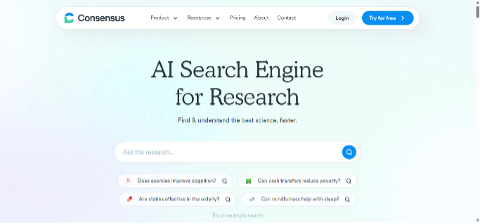
Consensus AI is an AI-powered search engine for researchers that scans its repository to answer your research queries, presenting you with supporting and opposing evidence to help you make more informed decisions. Users can type their queries into the search interface, and Consensus will generate results that you can then review and use for your research as required. The free version only allows for limited usage, with users prompted to move to one of the paid plans to unlock unlimited searches with $11.99/ month or $108 when billed annually.
Key Features of Consensus AI
AI Search: Consensus uses LLMs to generate reference-backed answers from its repository of 200Mn+ papers.
Consensus Meter: The flagship feature, this tool classifies references in the search output as 'yes', 'no' or 'possibly' indicating scientific consensus on your specific query or topic.
Pro Analysis: An extension of the AI Search feature, this mode allows users to do an in-depth search and analysis of the topic backed by references limited usage for free members.
Threads: This feature allows you to ask queries and carries the context forward for follow-up queries, so you don't have to repeat yourself.
Study snapshot: Provides a summary of papers, with a snapshot of the study's methods such as key takeaways, duration, methods, outcomes, etc., which allows you to assess relevance.
Ask Paper: This handy feature lets you chat with full-text papers to get in-depth answers and analysis, with responses highlighting where specific information can be found within the paper.
Consensus also allows users to create citations, upload and save relevant papers for later referencing, and search deeper using advanced filters to make the process easier.
How to Use Consensus AI?
Using Consensus AI is quite simple. Here's a step-by-step guide on how to leverage the tool and get the answers you need.
Go to consensus.app and enter your query in the search bar provided.
Consensus scans its repository for relevant papers and returns a response with percentage scores to help you understand whether the literature supports or negates your query.

Analyse the response, assess relevance and save relevant papers to the platform for later referencing.

You can do a deeper search using the filters, assess relevance with a study snapshot, or ask follow-up questions using the Threads feature. For literature where the full text is available, you can also chat with PDFs by selecting papers or uploading documents to Research Hub.
Pros and Cons of Consensus AI
Pros of Consensus AI
- Large repository: Consensus scans a database of 200Mn+ scientific papers, sourced from Semantic Scholar, OpenAlex, and its own web crawls, ensuring access to research across domains
- Consensus Meter: With consensus meter researchers can see what references support their hypothesis, opposes it or are neutral about it helping to make an informed decision about the topic.
- AI Search: Get reference-based answers from the semantic scholar repository for questions
- Good Interface: While limited in features, the clean and user-friendly interface helps users navigate the platform easily
Cons of Consensus AI
- Limited features: With only AI search as the primary feature, for researchers in their literature review and discovery process consensus can be limiting
- Restrictive usage: The core offering, AI search is restricted by limit in the free tier prohibiting the usage
- Expensive: With limited features and thereby limited value offered to the users the subscription cost is expensive for users
Best Consensus AI Alternative: R Discovery
R Discovery, the highest rated product in its space is an end-to-end literature review tools that offers free usage for its core features. R Discovery provides personalized reading recommendations based on user interests from 250Mn+ research articles, sources from trusted aggregators like PubMed, PubMed Central, CrossRef, Unpaywall, Open Alex and top publishing houses. R Discovery transforms how you access literature, helps organize references with curated reading feeds, and boosts comprehension with the option to Chat with PDF, translate and read or listen to research in your own language.
Key Features of R Discovery
- Personalized Literature Recommender: R Discovery's powerful AI recommendation engine suggests the latest literature tailored to user interests, reading habits, and search patterns, using a holistic contextual search that prioritizes relevance over citation counts for free!
- Extensive Database: R Discovery has the cleanest, most up-to-date repository of 250Mn+ research articles, including peer-reviewed journal articles, open access papers, conference documents, preprints, patents, and more. Covering 9.5M+ topics across 32,000 journals, this content is sourced from top aggregators like CrossRef, PubMed, PubMed Central, Unpaywall, Open Alex and leading publishers including Elsevier, Springer Nature, Taylor & Francis, SAGE, JAMA, NEJM, IOP, BMJ, and Karger.
- Ask R Discovery: Built on proprietary LLMs, R Discovery's AI assistant delivers factual answers with links to verified sources, ensuring accurate, hallucination-free support.
- Institutional Access: R Discovery allows users to read articles behind journal paywalls by using their institutional credentials; this improves access to high-impact literature and ensures a seamless reading experience.
- ChatPDF: Chat with articles to gain insights backed by references, generate summaries. You can also upload your own files to chat across web and app for seamless integration.
- Literature Map: Visualise similar papers using a graph network to find connections between them, find research gaps to do your literature review faster and better.
- Research in Shorts: R Discovery analyses and extracts key highlights, showcasing this as quick 2-minute summaries that allow users to evaluate articles faster.
- Similar Papers: Using its robust semantic search capabilities, R Discovery suggests research papers related to your interests, going beyond citations to include newer papers and preprints, empowering users to stay updated on fast-moving fields such as Artificial Intelligence and Biotechnology.
- Paper Summarization: R Discovery saves time by generating quick summaries of papers, which enables users to simplify and accelerate the literature review process.
- Accurate Translation: Users who do not have English as the first language can gain from AI translations in 31 languages. This allows you to read or listen to research papers on the platform or upload and translate your own documents.
- Audio Streaming: R Discovery allows users to listen to papers on the go, ideal for keeping up with literature while multitasking or commuting. You can create audio playlists of top papers, listen to abstracts of full text, or upload articles from your own library and listen in your preferred language.
- Multi-Platform Access: Unlike Scite, R Discovery is available on the web, as a mobile app (iOS, Android), as a Chrome extension, and as a ChatGPT plug-in (Ask R Discovery), with support available for Japanese and English.
How to Use R Discovery
Go to https://discovery.researcher.life/ and sign up for free.

From the features tab, go to Top Papers. Set up your research feed by selecting some areas of interest that you want to stay updated on.

Once you have selected your preferred topics, click on 'Create My Feed' and R Discovery's powerful AI engine will scan its database and populate your feed with the latest, most relevant reading recommendations for you.

Discover the latest and most relevant papers of discovery through your feed. You can also edit the feed to include topics, change weightage as per your preferences.
R Discovery's AI recommendations will continually evolve and improve based on your reading preferences and habits, doing the work to find you the latest papers to read, so you can focus on more meaningful work – your research!
How is R Discovery Different from Consensus AI?
| Feature | R Discovery | Consensus |
|---|---|---|
| Target Audience | Students, researchers, libraries and other academic professionals | Researchers, students |
| Literature Recommendations | AI literature recommendations based on user interests, reading habits and preferences. | Not available |
| Research Database | 250Mn+ papers, including journals, preprints, peer-reviewed papers, open access papers, and more | 200Mn+ research papers |
| Chat with PDF | Chat with PDFs on articles where licenses allow or your own PDFs to generate summaries, get insights and answers backed by references. | Ask Paper allows you to chat with papers, upload your own papers to generate summaries insights backed by references. |
| Generative AI Assistant | The Ask R Discovery feature presents summarized insights backed by verified links. Also available as a ChatGPT extension. | AI search that answers your queries backed by references. It also features a consensus meter that classifies the evidence. Also available as a GPT plug-in. |
| Related Research Papers | Similarity-based search shows all related papers, allowing users to see relevant papers across fields, regardless of citation count. | Not Available |
| Audio Streaming | Offers multi-lingual audio, where users can select or upload articles and listen to abstracts, full papers, or specific sections. | Not Available |
| Paper Translation | Provides accurate translation for papers in 30+ languages, without changing context or meaning. | Not Available |
| Collaboration Capabilities | Allows users to create, share, and collaborate on reading lists with fellow researchers. | Not Available |
| Research Summarization | Generates instant summaries; Research in Shorts feature shares key takeaways for faster reading | Not Available |
| Institutional Access | GetFTR, Libkey integrations allow users to read paywalled full-text papers with institutional logins | Not available. |
| Reference Managers | Auto-sync reading lists with Zotero or Mendeley. Export references from Ask R Discovery in any format. | Manually export references to reference mangers. |
| Writing Assistance | Not Available | Not Available |
| Accessible Across Platforms |
|
|
Who Should Use R Discovery Instead of Consensus AI?
Consensus AI is a great tool for searching research queries in a scientifically sound way. However, if your research demands more — staying on top of the latest studies, consuming literature efficiently, organizing your findings, generating insights, identifying research gaps, and tracking adjacent work — then look no further than R Discovery.
With its category-defining, AI-powered capabilities that uphold the sanctity of research, R Discovery is your perfect companion for researching better and faster than ever before. It helps you save over 70% of the time typically spent on literature reviews while significantly boosting your productivity.
Frequently Asked Questions
How suitable is Consensus AI for academic research or thesis writing?
Consensus AI is a great tool for asking a research query. However, it doesn't help you further — it doesn't support keeping track of research in your domain, accessing full texts, consuming literature, organizing it, or generating insights from it to save over 70% of the time spent on manual processes and improve your research productivity.
That's where R Discovery comes in. It helps you stay updated with the latest research, efficiently consume and organize literature, identify gaps, and track adjacent fields — making it your ideal companion for the entire research journey.
To take it a step further and write your research, you can then use Paperpal, our AI-powered academic writing tool that helps you paraphrase, edit, and write — all while keeping you in control.
What makes R Discovery a better tool for literature review?
R Discovery is designed to be an end-to-end research tool that supports you at every stage of the literature review process. We've built it with the unique needs of researchers at its core — helping you save time on manual tasks and boost your productivity so you can focus on meaningful, timely research.
Unlike other tools, R Discovery enables you to track research through AI-powered feeds, access literature via your institutional credentials or our repository of 250 million+ papers, consume research in your native language, generate insights, organize your findings, and seamlessly share and collaborate with fellow researchers.
How is Ask R Discovery different/better from the Q&A feature in Consensus AI?
Ask R Discovery queries a database of over 250 million papers — including the world's largest collection of 40 million open-access papers — to ensure you never miss out on key research in your domain. Unlike the basic Q&A functionality in Consensus AI, Ask R Discovery is built with an agentic AI workflow that takes AI-powered search to the next level.
It is also deeply integrated into the R Discovery platform, so once you find relevant sources, you can easily organize them, create citations, add them to reading lists, collaborate with fellow researchers, and generate insights and summaries using tools like ChatPDF. This seamless integration into your research workflow makes Ask R Discovery not just a search tool, but a comprehensive research assistant.
